「AIの人質になっている」— GLOBIS学長が示した警鐘、MPower村上由美子が語る『5年の猶予』、そして日本の『数学・読解世界一』教育が突然AI時代の資産に変わった理由(T4IS 2026『AI時代の学び』パネルレポート)
Tech for Impact Summit 2026『AI時代の学び』パネル、村上由美子(MPower Partners)、廣瀬聡(GLOBIS経営大学院学長)、児島真衣子(Crafter/マネックス)登壇、Financial Timesハリー・デンプシー司会。日本に与えられた5年の猶予、ChatGPTに思考を外注するMBA生をクラスで指摘した話、そして日本企業の6割がAIを導入したが社員はほとんど使っていない構造の話。
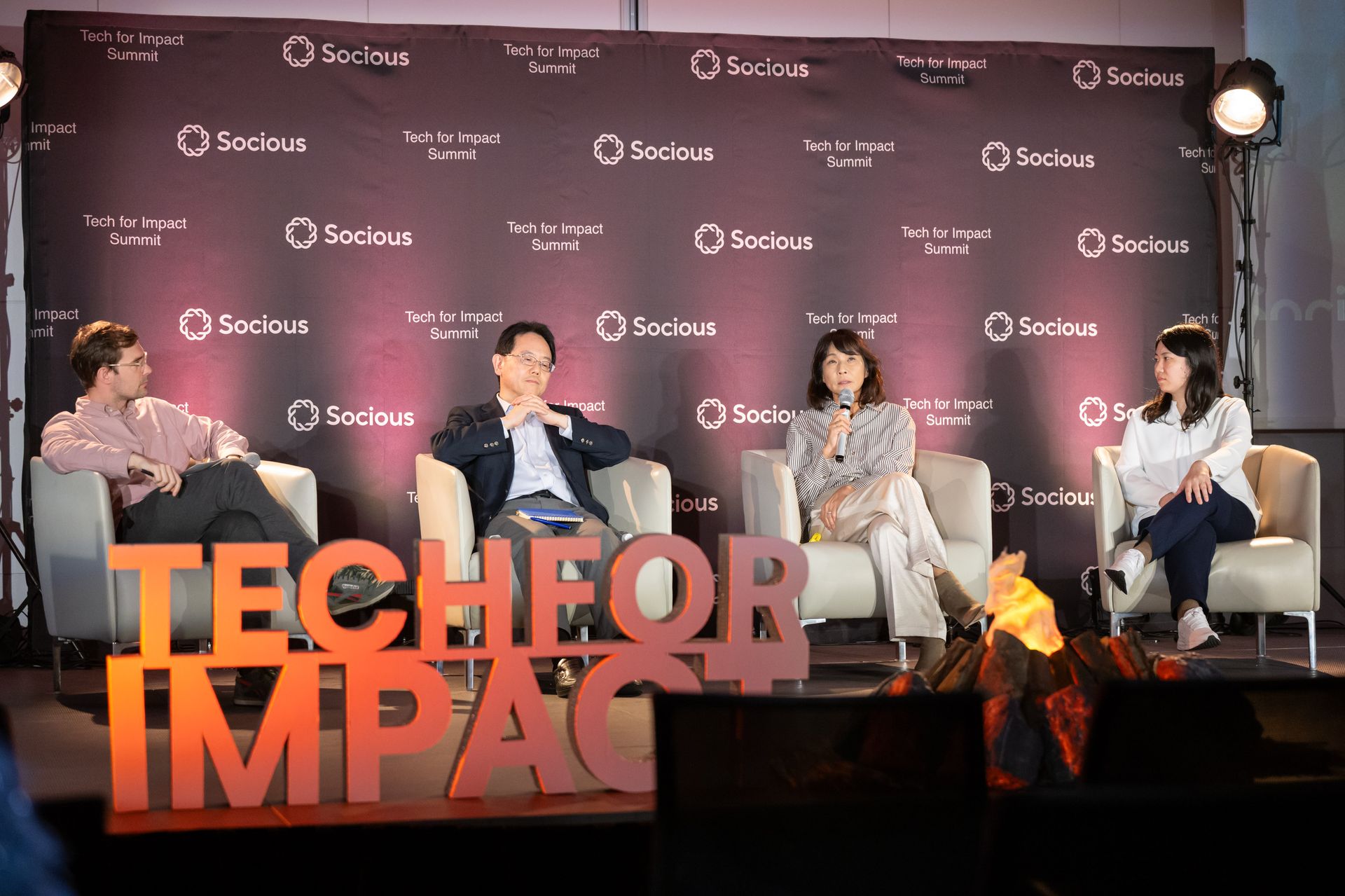
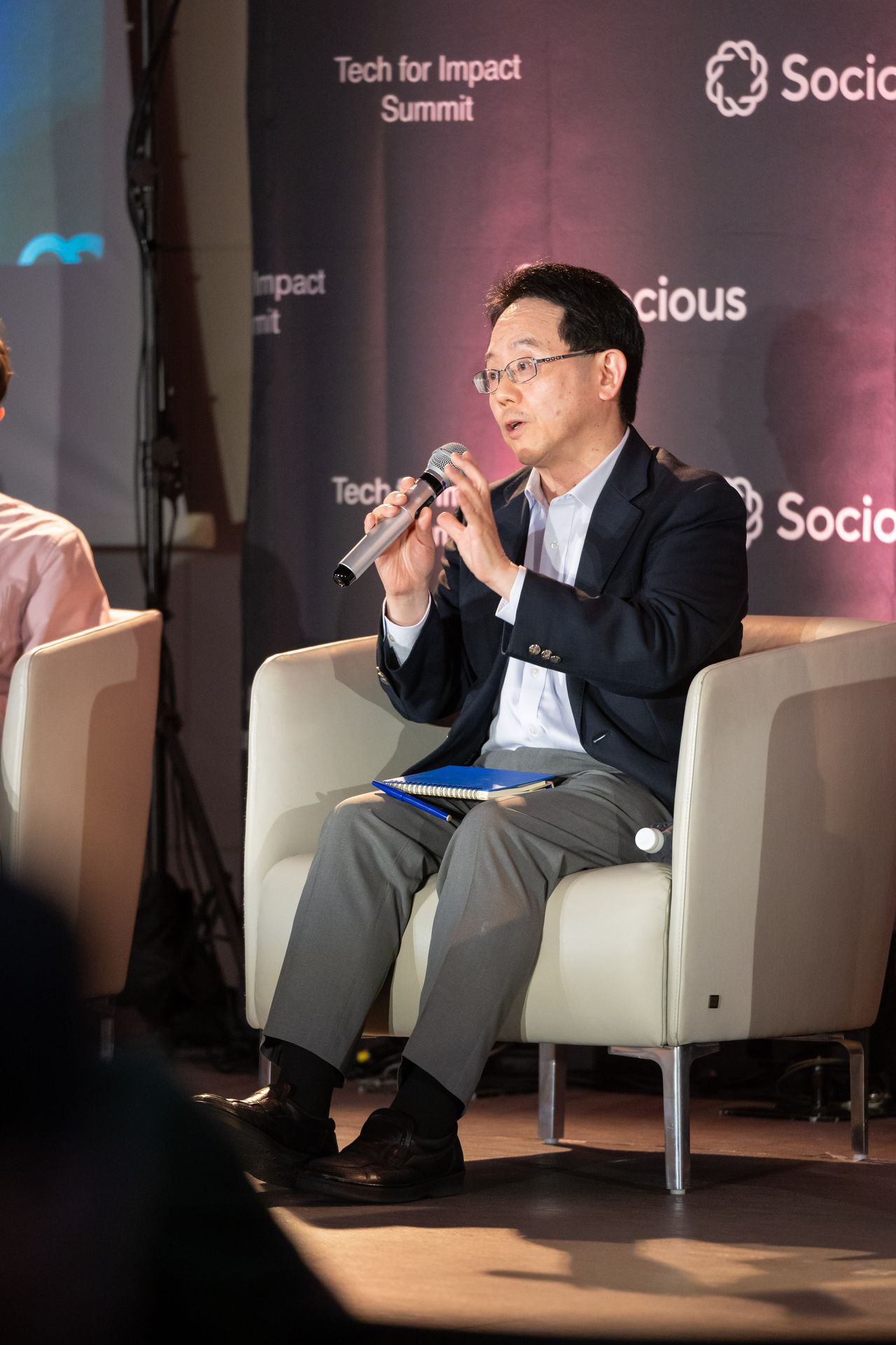
The line that got the longest pause from the Tech for Impact Summit 2026 audience came from Satoshi Hirose, Dean of GLOBIS University’s Graduate School of Management, halfway through the Learning in the Age of AI panel.
“Gradually, they are students who are, in a lack of a better word, like, prisoned by, hostage by AI.”
He was describing what he sees in his global English MBA classrooms when he asks a fragmented question and a student raises their hand thirty seconds later with a polished answer. He follows up: how did you come to that idea? Most of the time, he said, the student tells him openly: that’s AI’s answer. The thinking step was skipped. The student had simply read what ChatGPT or Gemini said and re-spoken it.
That moment framed the rest of the conversation. The Main Stage panel — moderated by Harry Dempsey, the Financial Times’ Tokyo Correspondent and a self-described new father with a six-month-old daughter — assembled three of the people in Japan most directly responsible for translating the AI shift into curriculum, capital, and corporate adoption. The argument they built, together and against each other, is the most useful map we have heard for what Japan’s AI-education window actually looks like.
Who Was on Stage
Yumiko Murakami (村上由美子) is General Partner at MPower Partners Fund — Japan’s first ESG-focused global venture capital fund, which she co-founded in 2021 with Kathy Matsui and Miwa Seki. Before MPower, she spent seven years as Head of the OECD Tokyo Centre, leading economic policy work with Japanese government entities, after a near-twenty-year career at Goldman Sachs across New York, London, and Tokyo. She has served on the Prime Minister’s advisory boards under both the Kishida and Ishiba administrations, including on AI policy.
Satoshi Hirose (廣瀬聡) is Dean of GLOBIS University’s Graduate School of Management and a Managing Director at GLOBIS Corporation. GLOBIS holds roughly 40% market share of the Japanese MBA market and runs the largest venture capital arm in Japan, with approximately ¥200 billion (~$1.3 billion) under management. Hirose’s career spans derivatives trading at AIG, management consulting at A.T. Kearney, and a turnaround leadership role through the 2008 financial crisis.
Maiko Kojima (児島真衣子) is the founder and CEO of Crafter, an enterprise AI SaaS acquired by Monex Group in 2022. Crafter’s “Crew” platform — an AI search layer that sits on top of corporate knowledge bases — is deployed at 300+ enterprises. Her 2025 book, Textbook of Generative AI for Business (Gakken), is built on conversations with more than 1,000 corporate AI leaders. She also chairs the Women AI Initiative Japan and serves on the Generative AI Utilization and Promotion Association (GUGA) council that informs national AI policy.
Harry Dempsey of the Financial Times moderated.
The Five-Year Window That Japan Cannot Waste
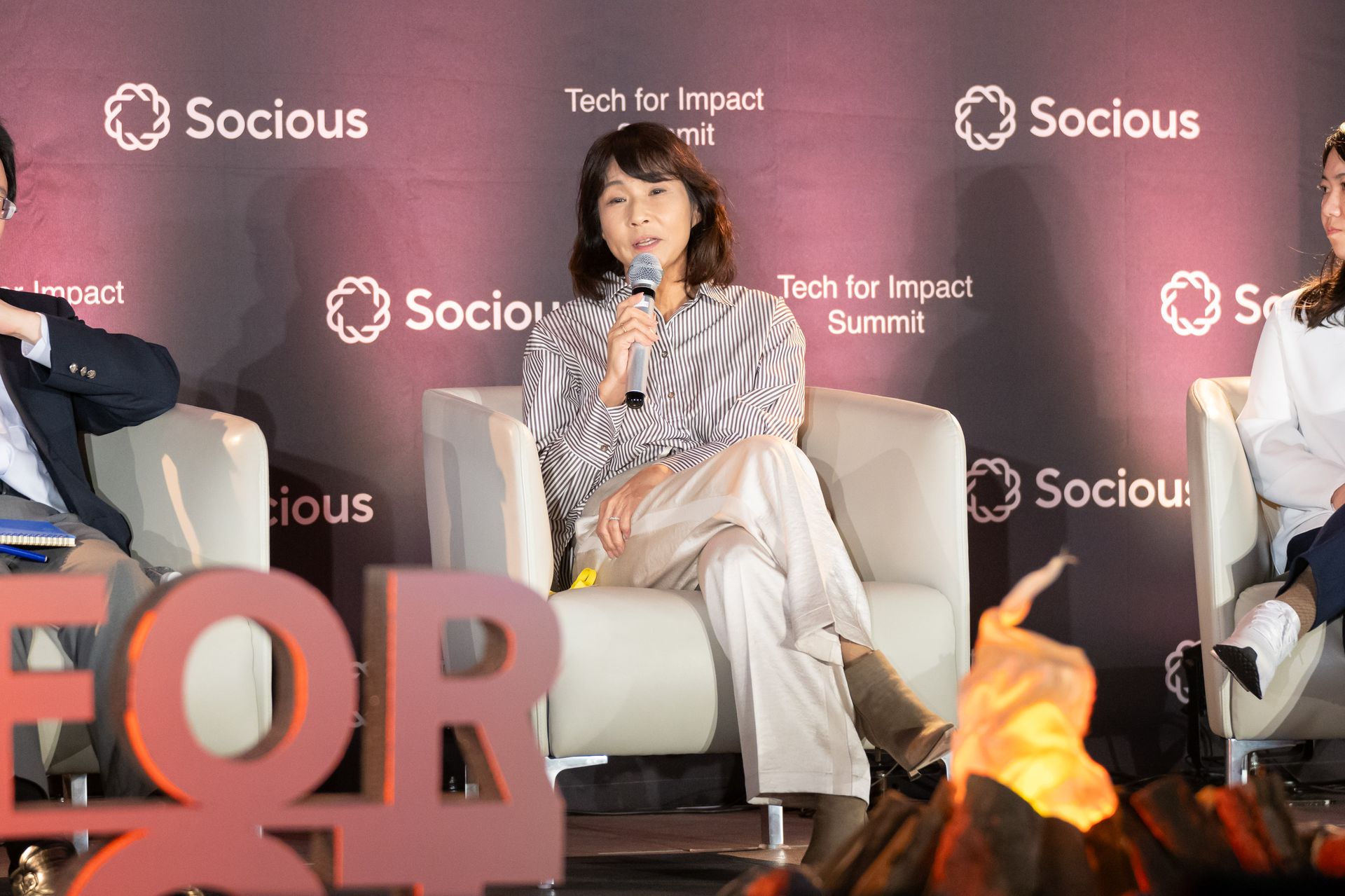
Murakami’s opening was the panel’s load-bearing argument. Japan’s AI policy direction was set by the government’s announcement last May — a “light-touch, innovation-first” stance, in deliberate contrast to the EU’s regulation-heavy approach — and reinforced by the Ministry of Education’s first basic AI policy, released last December.
The premise underneath both moves, she said, is that Japan does not have a choice.
“Japan is facing the reality and really embracing the reality that we don’t have people. We are rapidly shrinking. They are actually trying to embrace AI in the classroom in a very constructive manner. They’re starting with elementary school, which I think is great. That’s what’s needed because we don’t have a lot of people. So you have to start with the younger generation.”
Then she named the time horizon out loud — and this was the line that should sit on every Japanese CEO’s desk:
“Given the very limited time and given the advantage that they have, they’re really trying to move very quickly. It could be just five years. It could be just ten years. It could be two years, depending on how quickly these technologies develop.”
The advantage she was describing is one most countries do not have. Because Japan’s labor market is rigid and demographically thin, the immediate AI-driven layoffs reshaping entry-level work in the United States are not happening here.
“If you look at the U.S. right now, both startups and established companies, they are laying off huge, huge number of entry-level jobs. That’s not happening in Japan. That’s not happening at all in Japan.”
That gap is the window. The same labor-market rigidity that the global business press has spent thirty years calling Japan’s biggest weakness has, in this specific moment, become its biggest tactical asset — but only if companies use the breathing room to retrain rather than to delay.
Numeracy and Literacy World-Class. Critical Thinking, Not Yet.
The most counter-intuitive section of the panel turned the standard “Japan needs to catch up on AI” framing on its head.
Murakami, drawing on OECD PISA data she knows intimately, argued that Japan’s foundational educational outputs are world-leading. Japanese 15-year-olds rank at the top of international assessments in numeracy and literacy. The basic infrastructure has also been quietly built: every public school student has had a personal device since 2020 or 2021. The hardware layer is done.
What Japan has not yet built, she said, is the layer that matters most when the answer is no longer in the textbook.
“In the era of AI adaptation, that’s the ability — that’s the number one priority in terms of where education needs to focus on. Critical thinking. Can you think outside the box? There are many questions in the real world where there are no obvious right answers. And sometimes there is no answer. The Japanese education so far has been quite behind when it comes to developing this critical thinking ability among students.”
She was careful not to stage a wholesale rejection of the Japanese system. Her point was inversion, not replacement: a country that already has the foundational layer (math, reading, hardware in classrooms, light-touch regulation) does not need to start from zero. It needs to add one layer on top — the critical-thinking, question-formation, “create your own answer” layer — and it has roughly five years to do it.
“There’s an entrance exam to universities in Japan. You choose one of the four options because one of them is always the right answer. And we all know in real life, sometimes there’s no one answer. Sometimes there are no answers.”
The “Be the Same” Reflex GLOBIS Is Trying to Reverse
Hirose’s contribution to the diagnosis was personal. He took his elementary education in London, then returned to Japan in his teens.
“In UK, I was always asked, Satoshi, always be unique. You need to be different with others. When I returned back in Japan, always: why are you so different with others? You need to be the same. This is the only thing I believe that we can do better in terms of Japanese education.”
GLOBIS’s curricular response is to refuse to teach students what AI can already do, and to lean instead into the two things he believes AI cannot yet do: setting the goal (zero-to-one), and final decision-making.
The first lever is kokorozashi (志) — a Japanese word he glossed for the audience as “sense of mission.” Every GLOBIS student delivers a five-minute final presentation on what their kokorozashi is — what they want to use their life for. “This is something that I believe AI cannot still give you the right answer at this moment. This is what you have to think about.”
The second is the case-method discipline. “Each of the class faculties does not ask which is the right answer at all. What is your right answer? AI can give you great options, but it is ultimately you to make the final judgment.”
The third — and the one most relevant to corporate buyers in the audience — is what GLOBIS has trademarked as Technovate: every class, even finance and accounting, threads in how AI and big data reshape the discipline. All faculty are 100% practitioners, not academics, on the explicit theory that students need teachers who have made hard decisions, not teachers who can summarize textbooks.
“60% Have Adopted It. Almost Nobody Uses It.”
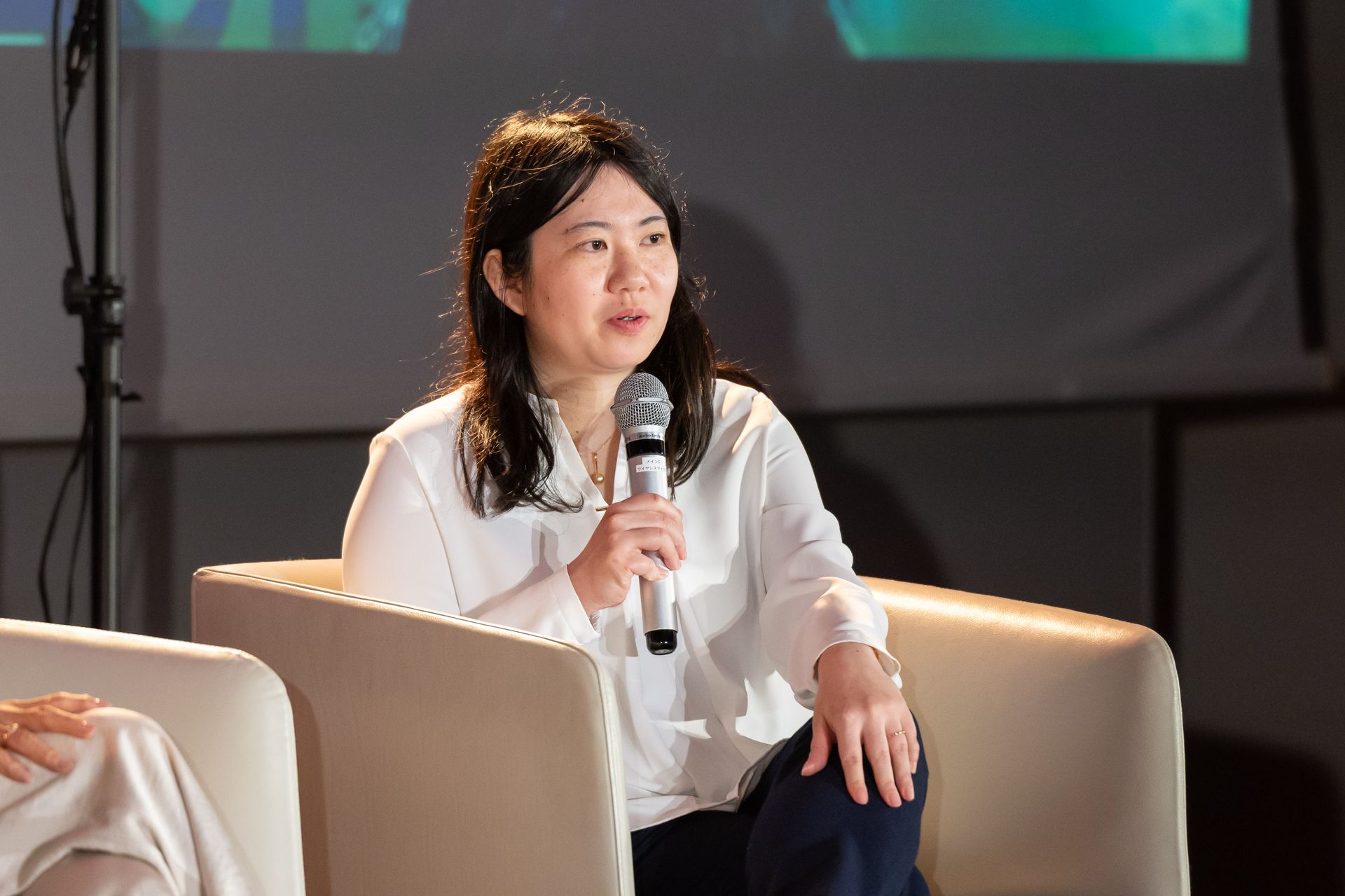
Kojima’s segment broke the corporate-Japan story in the way only someone who has sat across the table from 1,000 corporate AI leaders can break it.
The headline number is encouraging on the surface. Two years ago, she said, only about 20% of Japanese companies — including SMBs — had adopted AI in their business. NTT Docomo’s most recent enterprise survey, released two months ago, put the figure at 50–60%.
The gap between adoption and usage, however, is the actual story.
“They adopted AI, but not so many people, not so many employees are using their own AI. If they use it, it’s almost like very limited use cases. They only use it for surveys. They only use it for brainstorming. Those use cases are very good. But it has to be adopted on their own workforce, like the AI agent.”
When Crafter surveys employees post-rollout on what they need next, the answer is identical across companies: training and reskilling. And the training that is working, Kojima argued, is not productivity training. It is critical-thinking and source-evaluation training — the same layer Murakami had named as the missing one.
She pointed at Finland’s media-literacy curriculum as the model: teachers issue 18- to 20-item checklists, show students a video of a celebrity or public figure, and run a structured class debate on whether the video is real or AI-generated and, if fake, what its purpose is. Crafter is now porting this approach into corporate training. Not just for new hires — for the senior employees who are evaluating AI-generated content as part of their day job and have never been trained to interrogate a synthetic source.
“You have to be critical to understand what’s the, not only human, but also AI-generated content has become. You have to understand the objective of the creators.”
The Entry-Level-Job Question, From Three Sides
Dempsey closed the panel on the question every parent and every CFO is asking: if AI eats entry-level work — the dojo where new hires used to learn judgment — who trains the next generation of decision-makers?
The three panelists agreed on the diagnosis and split on the prescription.
Kojima’s answer was structural. AI-native juniors are not the problem. They are, in fact, the unlock. “They have more, they have been using AI very AI-native. If they see something inconvenient, they feel like, let’s put it in AI. It does the work better than you. The important thing the decision-maker has to do is embrace the usage of AI. Don’t be the person who stops the new type of usage.” The bottleneck, in her telling, is the senior layer — the people with deep domain skill but no AI fluency, who can either accelerate the transition or block it.
Murakami’s answer was capital-allocator’s. She is investing in what she calls the AI-utilization layer specifically because Japan’s labor structure protects the runway. “It gives companies a little bit of a breathing space. It gives people the time to think about what they should do — not to replace people, but to retrain, reskill, and upskill.”
Hirose’s answer was the warning that opened this recap. Among his older part-time and online MBA students — average age 35 — he sees AI used as an idea-enhancer. Among the younger trial-class cohorts he teaches abroad, he increasingly sees “people who are accustomed or hostage in AI, and do not think by their own words.” If that pattern hardens, he said, “it will stop the thinking process. And this is something that we need to be very, very careful.”
What This Connects to in T4IS2027
Three threads from this panel will carry directly into the next summit.
The first is AI as critical infrastructure for shrinking economies. Japan is the leading-edge case for what every developed economy will face in 10–20 years, and the policy and education choices being made now will become the playbook other countries copy or reject.
The second is the corporate-AI deployment gap — the question of why 60% adoption translates to single-digit active usage and what closes the loop. Kojima’s domain is exactly this seam.
The third is what humans should actually be educated for when the cost of an answer trends to zero. Hirose’s kokorozashi framing — start with the question of what your life is for, then use AI to help execute against it — is one of the cleanest articulations of the post-AI curriculum we have heard, and it will be back on stage in 2027.
If your organization is sitting on top of one of these threads — running a corporate reskilling program, building an education-tech company, advising on AI policy, allocating capital into the AI-utilization layer — these are the conversations the next summit is being built around. The membership and application page is at tech4impactsummit.com/membership.