日本の逆襲:3人のWeb3ベテランが語る、プライバシー・ステーブルコイン・TVLが意味を失った理由 — T4IS 2026 パネル
國光宏尚(gumi/Financie)、渡辺創太(Startale Group)、藤本真衣(zERC20/INTMAX)がTech for Impact Summit 2026のステージで、Web3ゲームの終焉、「暗号」を名乗る業界に欠けたプライバシー、実世界資産トークン化、ステーブルコインで決済するAIエージェントを語る。
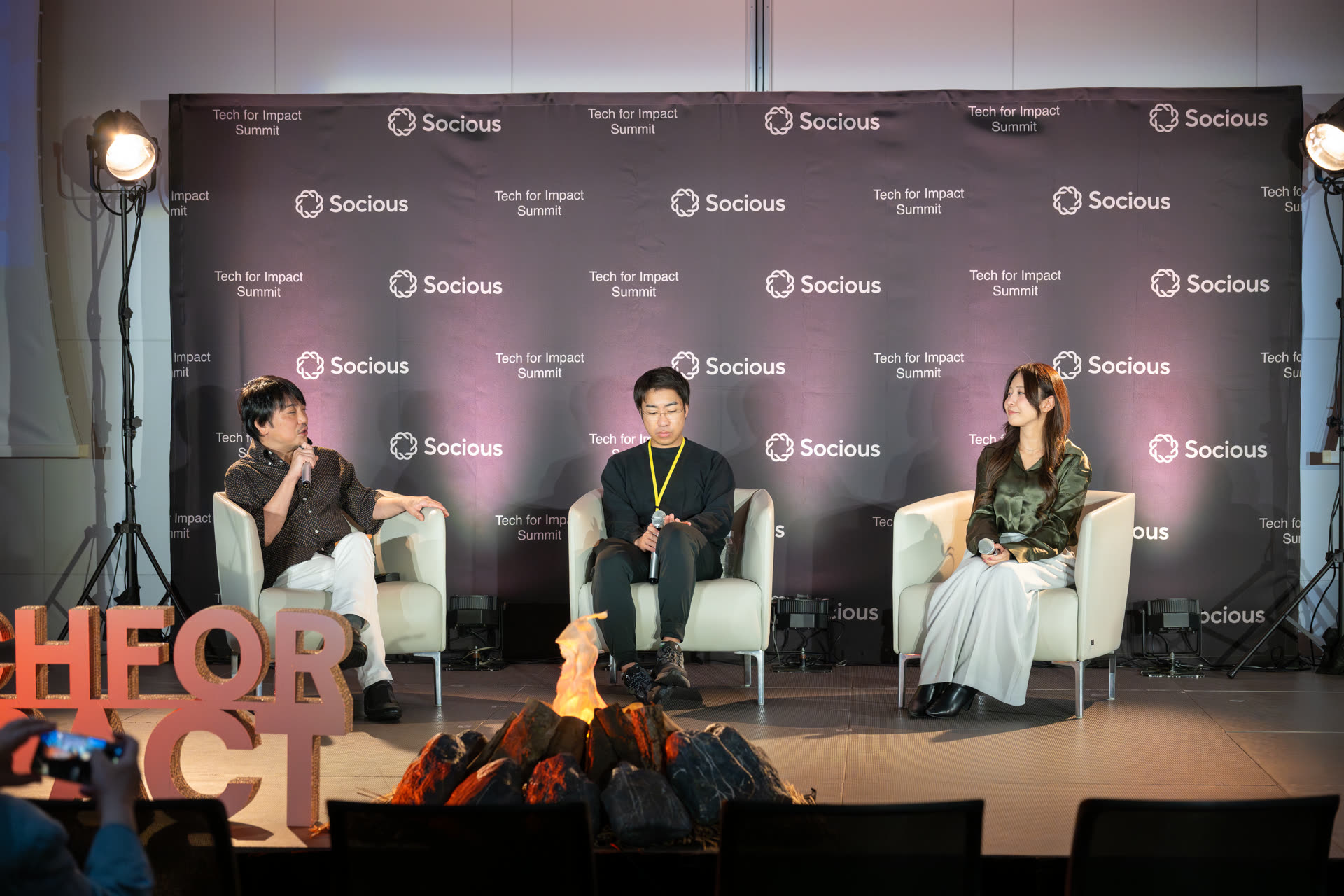
The most-repeated line from the Tech for Impact Summit 2026 Web3 panel was the one Hironao Kunimitsu used to open it.
“After more than a decade in this industry, the honest conclusion would be — we should’ve just bought Bitcoin and Ethereum and not built any companies.”
The room paused. Then he closed the loop. “We’re here to make sure that’s not the conclusion.”
Three of Japan’s most experienced Web3 founders had taken the Stage Dialogue room in Tokyo on April 26 — Hironao moderating from his own seat, no slides, no rehearsed framing. Over forty minutes they walked through what worked, what didn’t, and where the next decade of the industry is moving. The honest conclusion that Hironao opened with was a setup. The substance underneath was the case that the work has only just become useful.
The Three Founders on Stage
Hironao Kunimitsu is the founder of gumi Inc., one of Japan’s earliest publicly-listed mobile gaming companies, and currently CEO of Financie, MintTown, and Thirdverse. He is also a partner at gumi Cryptos Capital and an advisor to Trico, an Ethereum-based Digital Asset Treasury initiative. He is based in Singapore.
Sota Watanabe is the founder and CEO of Startale Group, the company behind Soneium — a Layer-2 network developed in partnership with Sony Block Solutions Labs — and Stream, a stablecoin and on-chain finance project developed with SBI Holdings. He is based in New York. (Watanabe also delivered a separate Main Stage session at T4IS 2026, recapped in our Sota Watanabe speaker spotlight.)
Mai Fujimoto is the CEO of zERC20, a privacy protocol designed to bring confidential transactions to every EVM chain, co-founder of INTMAX, and the longtime organizer of Japan Blockchain Week. She is widely known in the Japanese Web3 community as “Miss Bitcoin.” She is based in Zug, Switzerland.
What Didn’t Work
Kunimitsu opened the substantive section of the panel with a clean-eyed appraisal of the past three years.
The Web3 gaming experiment, in his telling, is over. Several high-profile titles — including a Captain Tsubasa Web3 game his portfolio touched — failed to retain users at the scale required to sustain a full-economy game. The mini-app distribution wave on Telegram and LINE produced large top-of-funnel numbers — millions of users in aggregate — but, in his account, only a small minority of those users stayed once the speculative incentive dropped away.
The lesson Kunimitsu drew was not that gaming is the wrong category for Web3. It was that the model of layering token incentives on top of a thin gameplay loop has run its course, and the founders still building need to choose between deeper game design or moving the Web3 layer into infrastructure that powers other categories.
TVL Is a Vanity Metric
Watanabe took the conversation to the L1 and L2 chain landscape. The narrative most observers had been carrying for the past two years — that dozens of Layer-2 networks would each find a defensible niche — has not survived contact with the data, in his view. The wars converge to a small number of chains. The networks that survive are the ones that own a vertical end-to-end: a chain plus a wallet plus a stablecoin plus a dominant application.
He delivered the line that the L2 industry has been avoiding in public: “TVL is a vanity metric. Fee revenue is the only number that backs a token’s value.” Total Value Locked is, in his framing, an inventory measure that mostly reflects financial engineering. Fee revenue tells you whether anyone is willing to pay to use the network for actual work.
The Privacy Gap
Fujimoto’s segment was the moment the room visibly shifted.
She opened by pointing at the most under-acknowledged structural problem in the industry: a sector named “crypto” — short for cryptography — that has effectively no privacy guarantees at the user-experience layer. Every transaction is public. Every balance is visible to anyone who can resolve an address.
The cost of that exposure is not abstract. In January 2025, David Balland, a co-founder of the French hardware-wallet company Ledger, was kidnapped from his home in central France. His captors severed one of his fingers and sent the image to his business partner as part of a ransom demand. He was rescued the following day in a French gendarmerie operation. The incident was widely reported and remains one of the highest-profile examples of how on-chain wealth visibility has become a physical safety problem.
Fujimoto referenced the case to make a structural point, then continued with her own experience. Years earlier, she had posted a public message about an NFT she owned, then traveled to Singapore for a conference. While she was speaking, a message arrived in her inbox in English: send Ethereum to a specified address immediately, or she would be killed. She filed a police report.
Her argument is that the technology to fix the privacy gap already exists, and is shipping. Zero-knowledge proofs make it possible to demonstrate facts about a person — that they are over eighteen, that they are a citizen of a particular country, that they hold a particular asset — without revealing the underlying data. ZK-based passport schemes are under active development across the industry. The blocker, in her view, is not the technology; it is regulators and platforms that have not yet learned to trust ZK proofs as substitutes for direct data submission. She has been working on that conversation for several years and continues to.
INTMAX, the protocol she co-founded, sits in the same domain — a privacy-preserving rollup architecture that aims to make confidential transfers a default rather than an opt-in.
Tokenized Real-World Assets and a JPY Stablecoin
The fourth thread of the panel was the migration of activity toward tokenized real-world assets — stocks, bonds, real estate, treasuries — and the role Japan needs to play in it.
Watanabe was direct: the United States is currently ahead, and Japan needs a yen-denominated, trust-type stablecoin to participate in the on-chain settlement layer that real-world-asset tokenization will run on. Stream, the project he is building with SBI Holdings, is shipping a yen stablecoin in June. He framed it as the missing piece between Japanese institutional capital and the on-chain RWA market.
Kunimitsu added the venture-capital lens. Trico, the Ethereum-based Digital Asset Treasury he advises, is positioned as Japan’s answer to MicroStrategy’s Bitcoin treasury strategy — but on Ethereum rather than Bitcoin. The thesis is that productive on-chain assets, secured by Ethereum’s settlement layer, can serve as a corporate balance-sheet primitive in the same way Bitcoin has for a small but growing set of companies.
AI Agents Will Use Stablecoins Before They Use Banks
The closing thread of the panel connected directly to two other sessions at T4IS 2026 that ran the same day. Yat Siu, on the Main Stage, had argued that AI agents cannot easily open bank accounts, and would therefore need an on-chain settlement layer to function in the economy. Masaaki Taira, the former Minister for Digital Affairs, then announced that the LDP’s Next-Generation AI and On-Chain Finance Task Force was preparing recommendations on exactly that topic, with publication scheduled for after Golden Week.
The Web3 panel landed in the same place from a different starting point. Watanabe’s framing: AI agents will open on-chain bank accounts long before any traditional brokerage or bank issues them an account. Stablecoins will function as the settlement layer between AI agents transacting with one another. The infrastructure to support that is now the most concrete application of the existing Web3 stack.
Why It Mattered
The Japan Strikes Back panel was unusual for the summit because it was the rare session where three operators with more than a decade of practical exposure to the industry spoke without scripts and without PR framing. The honest opening — that simply holding the underlying assets would have outperformed building companies on top of them — set the tone. What followed was the case for why the work that comes next has changed shape: less speculation, more infrastructure; less TVL, more fee revenue; less consumer experimentation, more privacy and settlement.
Mai Fujimoto’s privacy warning was the line that stayed with the room longest. The argument that an industry called “cryptography” cannot continue to ship products with public balance sheets and unprotected on-chain identities is hard to refute, especially against the backdrop of the Ledger case. The closing implication for any T4IS attendee holding crypto was direct: this is the panel to watch.
About the Tech for Impact Summit
The Tech for Impact Summit is an invitation-only executive gathering in Tokyo, convening leaders across business, policy, and culture to deploy high-impact technology against humanity’s most urgent challenges. T4IS 2026 was held on April 26 at Tokyo Garden Terrace Kioi Conference, as a partner event of SusHi Tech Tokyo.
The full Japan Strikes Back panel recording is available on the Tech for Impact Summit YouTube channel. Search “Tech for Impact Summit” to watch the complete session.