「日本は先生、韓国は生徒だった」——ジェジュン・ソンが語る、K-カルチャーは技術スタックである(T4IS 2026 セッション・レポート)
Crit Ventures 創業者ジェジュン・ソン氏のT4IS 2026登壇録。韓国が文化輸出をどう「システム化」したか——モバイル・AI・プラットフォーム基盤の構造分析。
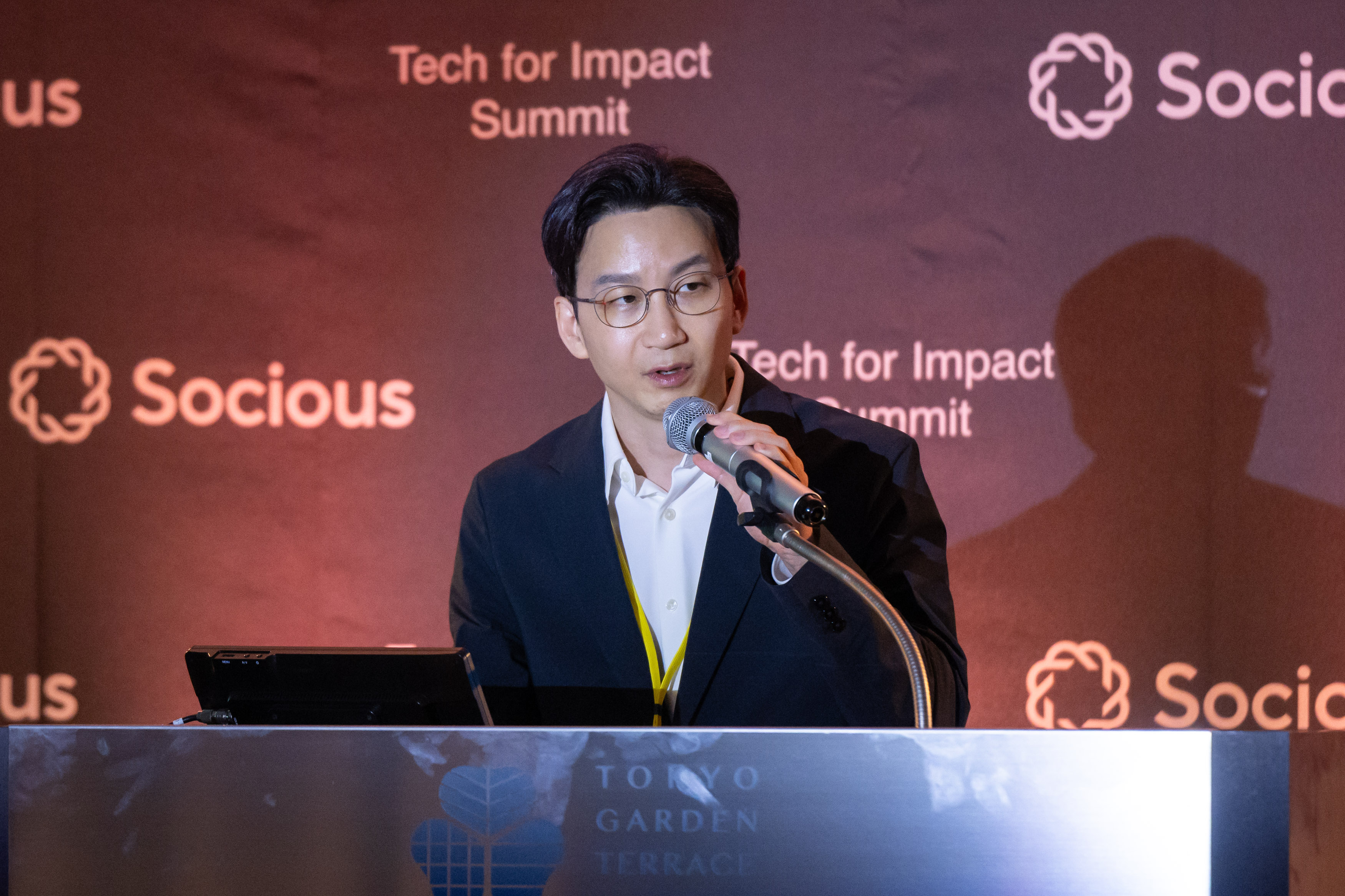
“26 years ago, when I co-founded Gameville in Seoul, the cultural center of Asia was this city here. Manga, anime, games, J-pop. Japan was the teacher, Korea was the student. Something has changed — not because Japan got weaker, but because Korea found a new rail to run on. Those rails were built with technology.”
That was Jaejoon Song’s opening at Tech for Impact Summit 2026 — delivered to a Tokyo audience that included executives from Japan’s largest media, gaming, and content businesses. It was a brave way to start. He is, after all, the founder of Crit Ventures, which holds roughly $240 million across 100+ portfolio companies and is built almost entirely on the K-culture thesis. He was, by his own framing, the student returning to the teacher’s house with receipts.
The receipts were the point.
Who was on stage
Song is the rare Korean operator who has built across every layer of the K-content stack. Year 2000, Gameville — the world’s first mobile games on black-and-white feature phones. 2013, Com2uS, which he acquired; Summoners War went on to over $3 billion in revenue across 200 countries. 2020, Crit Ventures, based in Seoul, LA, and Palo Alto. “Everything I share today, I have built or invested in,” he told the room. That biography mattered: the session that followed was not theory. It was a portfolio operator explaining how the rails worked.
His thesis was direct: “The K-wave didn’t happen by itself. It was built on technology — mobile distribution, AI recommendation, streaming platforms, webtoon infrastructure, game design. None of this is glamorous. You don’t see it when you watch Squid Game. But it sits underneath everything.”
Part one: the scale
Song opened with a data salvo. Korea — a country of 51 million people — is now the world’s number-two exporter of on-screen content. South Korea accounts for 17% of the top 500 most popular non-US shows and films on Netflix (Ampere Analysis, 2025), with Korean content driving roughly 8% of global Netflix viewing hours. Squid Game Season 2 alone topped Netflix’s H2 2024 charts, accumulating hundreds of millions of viewing hours in its opening weeks.
K-pop is the fourth-largest music export market in the world. K-cosmetics has now surpassed the United States — between January and April 2025, Korea exported $3.61 billion of cosmetics versus the US’s $3.57 billion, making Korea the world’s number two behind only France (Korea Herald, citing Ministry of Trade, Industry and Energy figures). Korean cosmetic exports hit a record $11 billion in 2025.
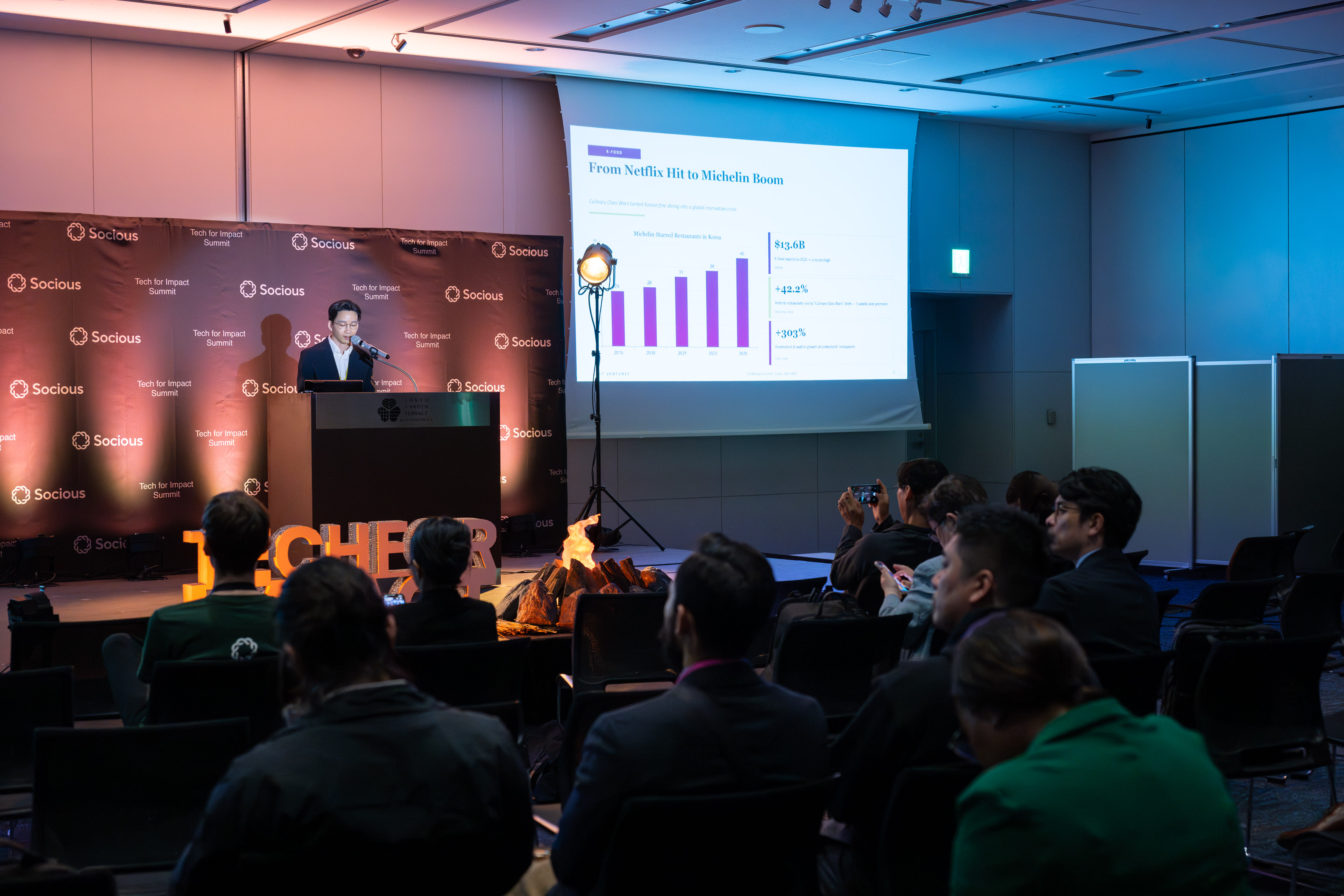
But the slide that stopped the Japanese audience cold was the one on digital comics. “The number one digital comics app in Japan — home of the world’s greatest manga tradition — is Piccoma. Made by Kakao from Korea.” Piccoma has been the top-grossing app in the Japanese mobile app market for five consecutive years from 2020 onward, pulling in hundreds of millions in consumer spending annually. “Korean infrastructure now carries Korean content and world content too,” Song said.
Part two: the Japanese pipeline vs the Korean funnel
This was the section that most rewarded a Japanese audience. Song was careful to be respectful: “Japan wrote the book on modern IP. Dragon Ball, Ghibli, Pokémon, Nintendo — you wrote the book. I learned from it.”
Then he set up the contrast.
The Japanese model, as he framed it, is a classic studio pipeline: manga first, studio-led, artist paired with editor, weekly serial, eventually anime and merchandise. “Deeply curated. Decades of compounding craft.”
The Korean model is a platform-native funnel: web novel first, written by amateurs on Munpia or Kakao Page. If it earns paid reads, it becomes a webtoon. If the webtoon lands, it becomes a Netflix drama. Then games. Then anime. “Both produce masterpieces. Japan starts with craft, then scales. Korea starts at scale, then craft emerges from the data. Neither is better. They are made for different eras.”
The case study was Solo Leveling. Stage one: an amateur named Chugong posted chapters on Kakao Page starting in 2014 on Munpia, readers paid per episode, and the platform saw what worked. Stage two: a 2018 webtoon adaptation that crossed over 14 billion views worldwide. Stage three: the Netflix anime adaptation, with A-1 Pictures in Japan as the animation studio. Stage four: a mobile game from Netmarble. “Nine years. Four platforms. Each stage de-risks the next.”
That last sentence is the operating principle. Korean web novel platforms inverted the editorial gate that traditional publishing — including Japanese publishing — has relied on for a century. “Anyone posts, readers pay by chapter, the platform sees what lands. That data filters the next stage. At every step, failure is cheap.”
Part three: K-pop is not a genre
The line that produced the most audible response from the room: “K-pop is not a genre. K-pop is a production system.”
Song walked through the five stages: scout (global auditions of 5,000–10,000 applicants per agency per year), train (three-to-seven-year contracts), debut (concept, visuals, fandom seeded before the first song drops), monetize (direct-to-fan), and localize. The crucial move, he argued, is that Korea is no longer just exporting K-pop music. Korea is exporting the K-pop system.
The examples were on the slide: NiziU, the all-Japanese girl group trained inside Japan by JYP and Sony using the K-pop apparatus, now number one in the domestic Japanese market. &TEAM, the HYBE Japan group. Dear Alice, the first all-British K-pop-style group, built with the BBC. KATSEYE, the global English-speaking girl group from HYBE.
“The members change. But the system stays.”
The monetization layer underneath is where Song really came alive. The old music model — label signs artist, artist makes album, label makes some money — has been rewired. The Korean model monetizes superfans directly. Weverse, owned by HYBE, has 12 million monthly users at 263 minutes per user per month and was profitable last year. Bubble, from SM and DearU, has 2.8 million paid subscribers paying $4 per month for what feel like one-on-one messages from idols. b.stage, from BeMyFriends — a Crit Ventures portfolio company — provides fandom infrastructure to roughly 1,000 artists. HYBE crossed $1.86 billion in revenue last year.
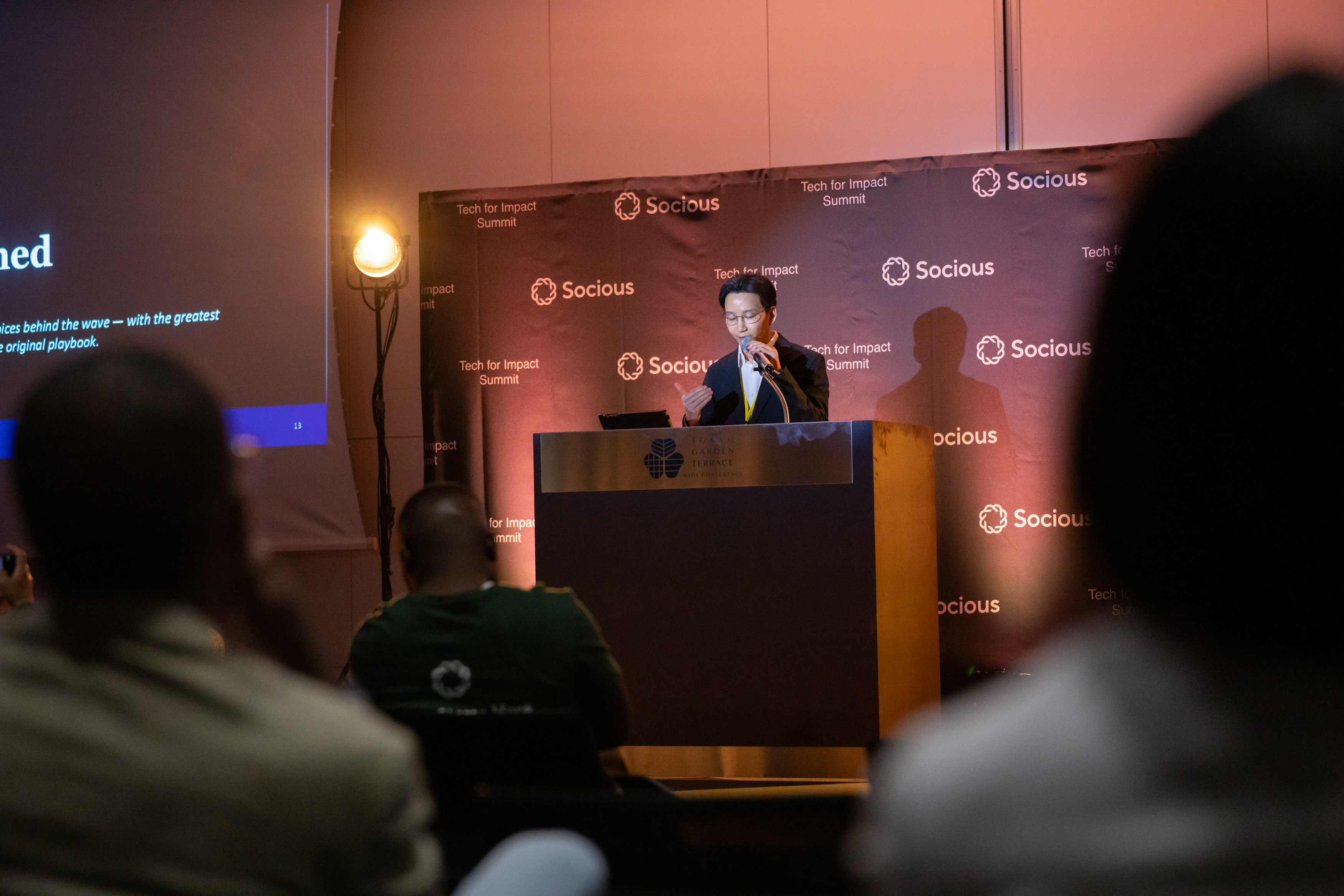
The K-beauty story rhymed. Korean brands don’t beat L’Oréal because they out-market L’Oréal. They beat L’Oréal because of a 20-year structural split: indie brands (COSRX, Beauty of Joseon, MediCube) on the storytelling side, and two OEM giants (Cosmax and Kolmar Korea, each over $1.3 billion in annual revenue) on the manufacturing side. “A new brand can launch with just $500,000 and hit number one on Amazon without ever owning a factory.”
What the audience took away
Song closed with five lessons — not for Korea, but for any country watching from the audience:
- Amateur-first platforms. Let ordinary people create before experts pick winners. Open the gate.
- Data-driven production. Every stage of the funnel needs a measurable signal. Stop guessing, start measuring.
- Systematize talent. Whether chefs, dermatologists, or idols, invest in training pipelines. Not one-off superstars.
- Own the distribution rail. Cultural export means owning the checkout, not just the content.
- Design for localization from day one. Export the system, not just the product.
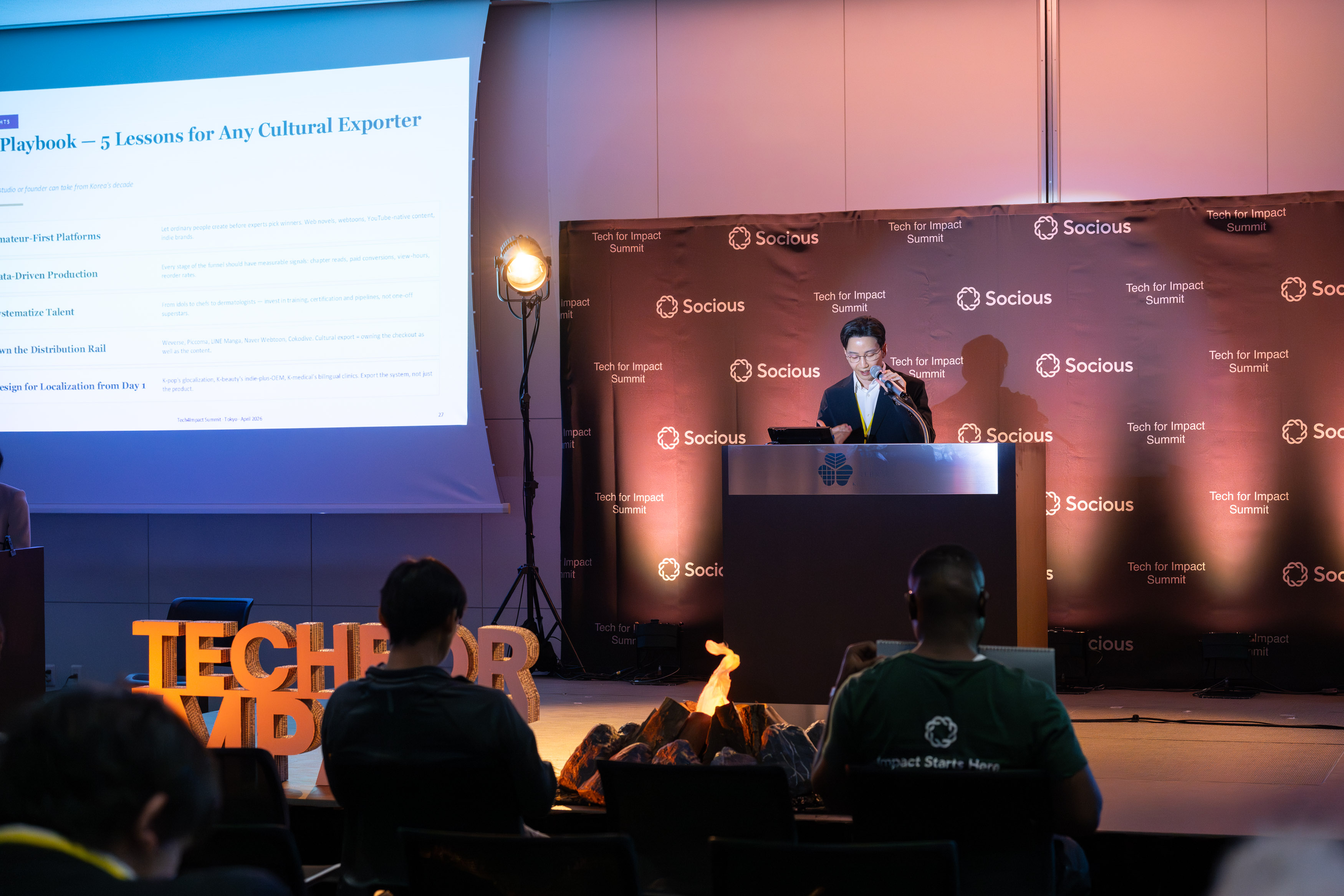
The session was generous in a way that mattered. Song was not preaching Korean supremacy — he was offering an operating manual. His closing line was the most pointed: “Every country here, Japan included, has cultural assets the world wants. The question is whether you have the platform, the data, and the wheel to carry them.”
Why this connects to T4IS 2027
Song’s argument is exactly the kind of conversation T4IS 2027 is built to host: it sits at the intersection of culture, capital, and infrastructure. The summit’s 2027 themes — AI-native creative production, Japan as a global innovation hub, plurality and the platforms that scale it — all live downstream of the question Song posed in Tokyo. Japan has the cultural depth. Korea built the rails. The next chapter is one neither writes alone.
It is also, frankly, the kind of session that argues for itself. Korea did not invent the cultural appetite for K-pop, K-beauty, or K-drama. It built the system that turned that appetite into recurring revenue across 200 countries. Whether the next exporter of that system is Japanese animation, Indian film, or African music, the operating playbook is now public.
T4IS 2027 takes place in Tokyo on May 18–19, 2027 as a partner event of SusHi Tech Tokyo — invitation-only, Davos-style. Search Tech for Impact Summit to learn how leaders in business, policy, and culture apply for a place at the table.