「気持ち悪いほどの均質性」— 英利アルフィヤ外務大臣政務官のクロージングが、T4IS 2026 全体の通奏低音を「代表性」に書き換えた
英利アルフィヤ外務大臣政務官がTech for Impact Summit 2026を締めくくった——ニューヨークの国連の机から3年半で4回の国政選挙へ。衆議院の女性比率10%→14.6%への変化、そしてAIガバナンスがなぜ「代表性」の問題になったのかを語った当日最も妥協のないスピーチ。
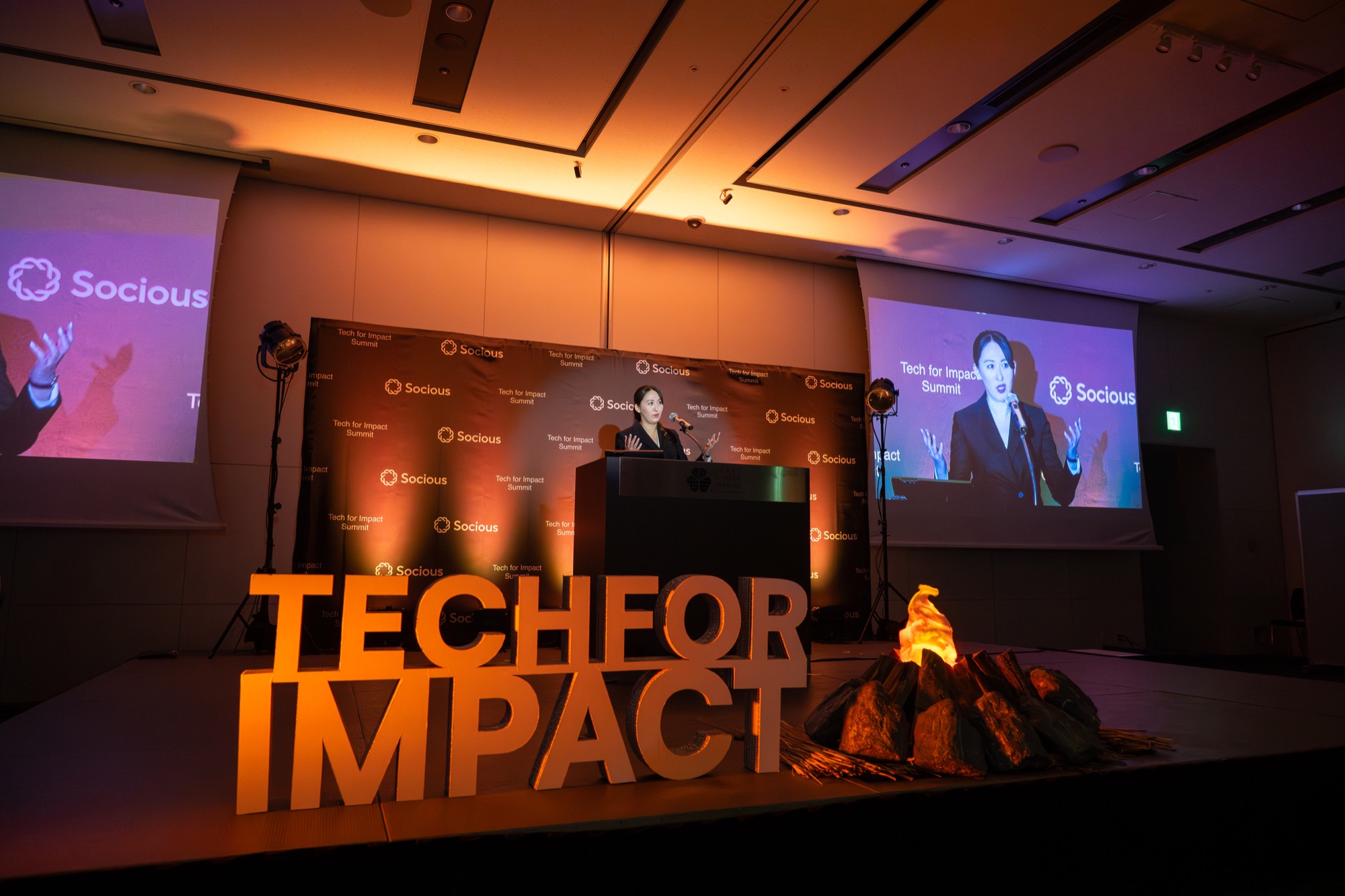
The most uncompromising line of Tech for Impact Summit 2026 was spoken in the room’s last hour, by the only Diet member on the day’s agenda who was under forty.
“I was working at the UN in New York. And from there, I saw this disgusting homogeneity of men, of men of a specific age group from a specific family and economic background, continuing to run and continuing to win.”
That was Arfiya Eri — Vice Minister for Foreign Affairs in the Second Takaichi Cabinet, three-term Member of the House of Representatives for Chiba’s 5th district, and the closing speaker at the summit on April 26 at Tokyo Garden Terrace Kioi. The room had spent the day listening to founders, investors, and a former Digital Minister talk about AI, Web3, capital flows, and K-culture. Arfiya’s job was to braid those threads into something the audience could carry out the door. She did it by refusing to soften the diagnosis that pushed her into politics in the first place.
From a UN Desk in New York to Four Campaigns in Three and a Half Years
Arfiya was born in Kitakyushu in 1988 to a Uyghur and Uzbek family. She studied at Georgetown’s School of Foreign Service, worked at the Bank of Japan from 2012, then at the United Nations Secretariat in New York from 2016 to 2022 — first in protocol roles, later as Special Assistant to a UN Assistant-Secretary General. She speaks seven languages.
What turned her into a candidate was a phone call. In 2022, watching Japanese politics from across the Pacific, she called Taro Kono — whom she knew through Georgetown alumni — to tell him, in her own words, “that this made me upset, and I found it to be very strange.”
“He told me that the next time I was back in Japan, I should come visit the LDP. So I did, a year later. And that led me to multiple meetings within 48 hours within the LDP. The LDP found my argument to be convincing, to my surprise. And they decided that I should run within two months. And so I quit my job at the UN, came back to Japan, ran my first national campaign in six weeks.”
She was told that three or four thousand votes would be a respectable showing for a candidate parachuted into a national race with a non-traditional Japanese name. In Japan, voters write a candidate’s name onto a paper ballot by hand. A name that has to be memorised and inscribed in kanji or katakana is a structural disadvantage; the system rewards political families whose surnames have been on local posters for half a century.
She received about 50,000 votes.
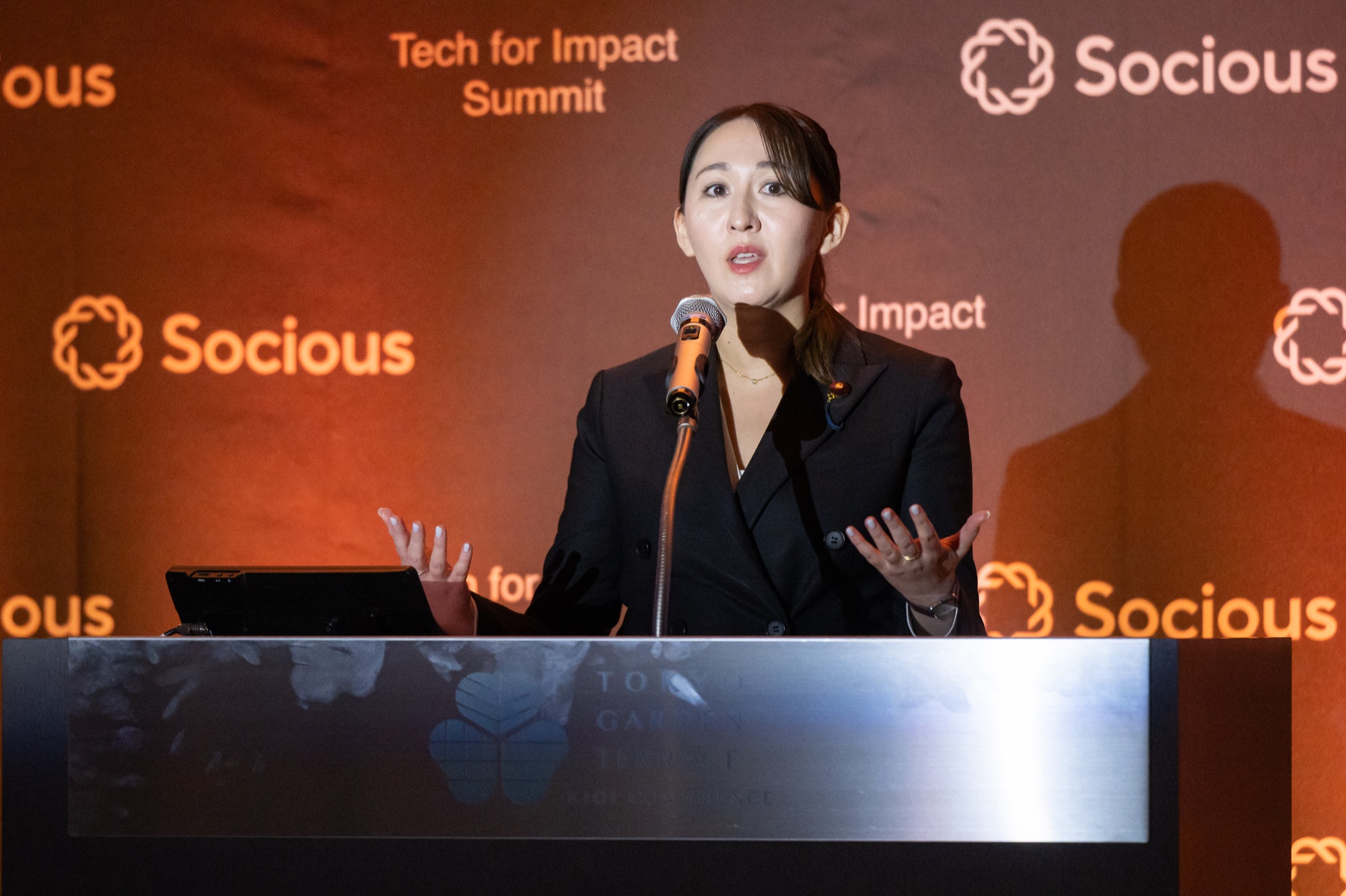
“For 50,000 people to have memorized my name within six weeks, go to the polls, and actually write that down nationally and make a statement that we need more representation — that meant a lot to me. And it also made an impact within the party.”
The LDP put her up again six months later for the Chiba 5 by-election — Ichikawa City and Urayasu City, one of the most internationally diverse constituencies in Japan, with residents from roughly 100 nationalities and a heavy commuter population in their thirties and forties. Her predecessor had resigned over a money embezzlement scandal. She had nine weeks to win.
She won by a narrow margin. The next year, with the party-funding scandal now a national story, she lost the constituency outright and re-entered the Diet through proportional representation. On her third campaign, the election was called at 8 p.m. with more than 80,000 votes to her name. A landslide.
The Numbers Underneath the Anecdote
Arfiya is not telling a story about herself. She is telling a story about a curve that has bent over the last five years — and a curve that, for the first time, can be measured.
- When she was first elected in 2023, only 10% of Japan’s lower house was female.
- Of the 40 first-term LDP MPs elected in her cohort, she was the only woman elected from a constituency seat rather than via proportional representation.
- After the following national election the lower house climbed to over 15% female; the most recent election dialed back slightly to 14.6%.
- The upper house has risen from roughly 25% when she ran to about 30% today.
- And, as she noted, “we now have a female prime minister too” — Sanae Takaichi, who took office in October 2025.
For decades these numbers barely moved. Now they are moving. That is not a side observation at an event about technology — it is the operating environment in which Japan will negotiate AI governance, foreign direct investment, and the post-2030 industrial policy that the day’s earlier sessions had been arguing over.
The Juxtaposition
Arfiya could have stopped at the domestic story. She didn’t. Her own brief as Vice Minister for Foreign Affairs covers Europe, Central Eurasia, Latin America, the Caribbean, and global Official Development Assistance, and she used the moment to name the tension in plain English.
“As Vice Minister for Foreign Affairs today, I also see a progressive shrinking space for democracy, human rights, civil rights, and rule of law worldwide. And so it’s almost a juxtapositional trend — where you see increased interest in diversity and representation, and more diverse voices domestically, but going out there in the world and finally representing a Japan that is interested in that, and being faced by a world that is less and less interested in creating a world that is more inclusive and more just and more equal.”
The framing — Japan as a democratic anchor under the “Free and Open Indo-Pacific” paradigm — was familiar in form. What was unfamiliar was hearing it from a thirty-something Uyghur-Uzbek-Japanese MP who reached the brief inside three and a half years.
Why So Few Women Still Run — The Three Structural Reasons
The most clarifying material in the session came in the question that followed. A young woman in the audience asked the version of the question that nearly every Japanese gender-policy briefing dodges: why are there so few female candidates? Doesn’t the data suggest that women simply don’t want to run?
Arfiya treated it as the central question and laid out three barriers, in order.
First, the workday. “Our days, for example, normally, if you belong to the LDP, you’re encouraged to stand in front of a station in your constituency every morning. That starts at 6 a.m. And then you get on a train, you come to Tokyo, and you have an LDP meeting at 8 a.m. … And then in the evenings, you have working dinners as well, or receptions if you’re in diplomacy. So your day, your expected day is from 6 a.m. to midnight.”
She continued: “Now, as you can imagine, even if you were not a woman — if you were a man in his 20s or in his 30s and his 40s raising children, taking part in childcare or caring for your parents, for example, or your family members at home, this is an impossible schedule to fulfill.”
The constraint, in other words, is not “women don’t want to run.” It is that the job has been architected around a candidate with no caregiving obligations of any kind. The data on Japan’s domestic burden distribution — still disproportionately on women — closes the loop.
Second, role models. Here Arfiya cited the most-quoted line of the day, from earlier on the Main Stage. “Kathy Matsui, who was here earlier, she always says: ‘you can’t be what you can’t see.’” (Matsui’s full Womenomics-to-founder-nomics fireside is recapped in our Kathy Matsui T4IS 2026 piece.)
Third, money. “Funders and sponsors still tend to fund men. It’s a lot harder for female — same with entrepreneurs, right? But female politicians to raise the amount of money that they need to run.” The morning session Women Building the Future — moderated by Bloomberg’s Lisa Du — had quantified exactly the same dynamic on the venture side: female founders in Japan raise about 60% less capital while reaching IPO 30% faster. Arfiya’s testimony was that the parallel pattern operates in politics, on a smaller stage but with downstream effects on every law the country writes.
Why the Closing Belonged Here
The reason a Vice Minister speaking about democracy and human rights closed an event whose earlier hours were dominated by AI, quantum, and Web3 became explicit in her last minute on stage.
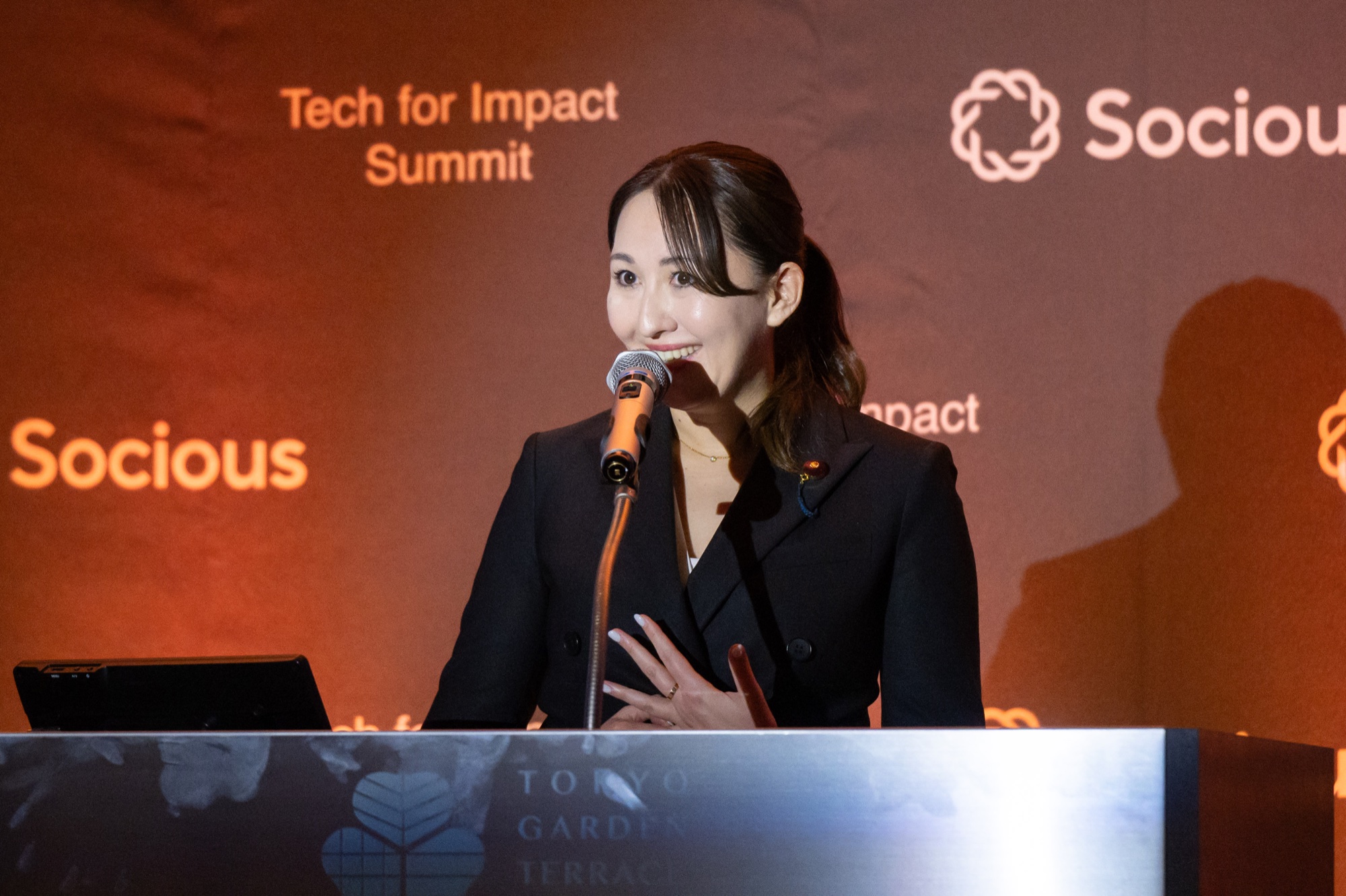
“As you think about AI governance and technology, I want you to think about the importance of representation, diversity, and the need for better governance and aspects of human rights to be incorporated in that too… As we talk about AI and technology, this will become more and more important.”
The line is a thesis, not a closing flourish. A country whose lower house is 14.6% female will write AI-governance frameworks that reflect that ratio unless something is deliberately done. The same is true of the country’s standards for facial recognition, for algorithmic hiring, for autonomous-systems liability, and for the foreign-policy posture Japan takes into the G7 and the Indo-Pacific. The Tech for Impact Summit’s central premise — that technological capability without political and ethical capability is a liability, not an asset — was given its most concrete civic expression in this session.
What T4IS 2027 Carries Forward
Three through-lines from the closing address will reappear in the next summit.
The first is the representation-as-infrastructure argument. Diversity is not a side panel; it is the precondition for AI governance frameworks that survive contact with the populations they govern.
The second is the Japan-as-democratic-anchor framing in a contracting global civic space. With a female prime minister, a rising cohort of women in both houses, and a foreign service brief that explicitly defends rule of law in the Indo-Pacific, Japan now has the credibility to convene that conversation. The summit will treat it as a working theme rather than an aspiration.
The third is the structural-barrier audit Arfiya modeled in the Q&A — workday, role models, money. The same audit applies to who runs AI companies, who founds climate-tech firms, and who advises ministries on technology policy. If T4IS 2027 has a single methodological commitment, it is to run that audit out loud on every session, not just the obviously gendered ones.
The closing line, delivered with eight seconds to spare on her own clock: “I hope that you do consider to run. These are barriers, but I think we can break them, with each person who tries to break that too.”
It is the kind of line that sounds, in a transcript, like a polite send-off. In the room, with the lights coming up on the second-to-last hour of the day, it landed as something closer to a draft notice.
The conversation Arfiya opened — representation, democracy, and the AI-governance question that runs through both — is the conversation the Tech for Impact Summit will continue to host. Senior leaders interested in joining the 2027 convening can begin the application from the membership page.