A story about the connection between the sounds of war and color
COLOROPERA is an audiovisual work that combines a libretto, a sound composition, and colored light. Inside the space, the viewer is almost moved into a human body that knows how the sound of war feels through color and becomes immersed in this story on a perceptual and bodily level.
It all began when Alevtina Kakhidze collected answers to the question: which sounds of war are important for Ukrainians and how they will remember this experience. She also asked what color Ukrainians feel these sounds of war are.
This large body of responses was processed by the artist, and based on this research Alevtina wrote a story consisting of four parts:
- ACT 1 — A Possible Future in Ukraine
- ACT 2 — The Past: A House on the Outskirts of Kyiv During the Russian Assault in February 2022
- ACT 3 — The Past: The Front Line
- ACT 4 — An Imaginable Victory

The process of creating COLOROPERA
The work is based on a research process for which Alevtina Kakhidze interviewed sixty Ukrainians — military, civilians, artists, as well as children and teenagers who left Ukraine. She asked them which sounds of war they recognize and what color they feel these sounds are.
Based on this large body of responses, Alevtina Kakhidze created a libretto consisting of four parts: about a possible future of Ukraine, about the experience of war for civilians and the military, and about the imagination of victory.
"I placed the part 'The Future of Ukraine' first. And then I began to tell about what has already become the past for us, and about what we imagine as victory."
— Alevtina Kakhidze
During the research it became clear that people often associate the sounds of war with particular colors, and the military even differentiate the intensity of these colors depending on the distance of the sound.
A special role in the work is played by "fake sounds of war" — sounds that for a moment are perceived as explosions: sneakers in a washing machine or flags at a cemetery moved by the wind.
"For some military, the sound of flags at a cemetery is the most frightening sound of war. Not explosions, but exactly this. Because for Ukrainian military, coming to a cemetery means coming to their brothers-in-arms. And this is the sound that is the most frightening for them. That is why I include this sound in the part of the opera that I call 'Victory'."
— Alevtina Kakhidze
The artist's personal experience also became part of the creation of the project: during the full-scale invasion she was in the village of Muzychi near Kyiv, where she heard the sound of mortar shelling for the first time.
"If I had not had the experience of war, maybe COLOROPERA would never have happened. I remember that at the end of March Muzychi, the village where I live, came under mortar fire. I heard the sound of mortars for the first time. To me it sounded like a very large dragonfly. I will never forget this sound."
— Alevtina Kakhidze
From these stories, memories, and research COLOROPERA emerged — an immersive audiovisual space in which sound, color, and light form a way of experiencing and reflecting on the experience of war.
Four Acts
A Possible Future in Ukraine
The first part opens the story with an imagination of a possible future of Ukraine. It invites the viewer to think about what life after the war might be like — a future that for now exists only in the shared imagination and hope of Ukrainians. By beginning the story with the future, COLOROPERA changes the usual logic of narration and invites the viewer to reflect on this.
The Past: A House on the Outskirts of Kyiv
This part brings the viewer into the experience of civilians during the Russian assault on Kyiv in February 2022. Through sound and color, it recreates the atmosphere of living next to war: the sounds of shelling, alarms, and the moments when people try to understand whether the sound they hear is an explosion or simply an ordinary domestic noise.
The Past: The Front Line
The third part turns to the experience of the military. It explores how the military on the front line perceive the sounds of war and how these sounds acquire color. The distance of an explosion, the intensity of the sound, and even "fake sounds of war" — all of this forms a particular system of perception.
An Imaginable Victory
The final part tells about the imagination of victory. In COLOROPERA, victory appears not as a triumph but as a complex emotional state inseparable from the memory of loss. In this part, the sounds that remind us of the fallen are also present — for example, the sound of flags at a cemetery, which for many Ukrainian military is one of the most painful sounds of war.
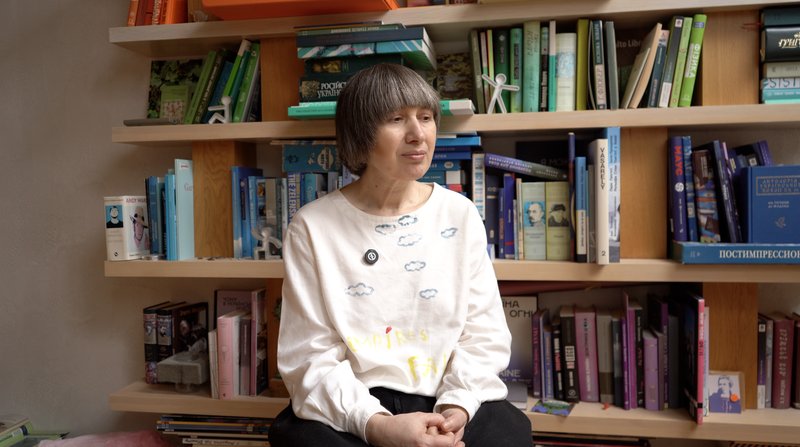
Alevtina Kakhidze
Alevtina Kakhidze is an artist, performer, curator, designer, educator, and gardener. She has served as a UN Tolerance Envoy in Ukraine since 2018 and is a recipient of the Kazimir Malevich Award (2008), the Women in Arts Award (2023), and a Special Mention of Ars Electronica.
Educated at the National Academy of Fine Arts and Architecture (Kyiv) and Jan Van Eyck Academie (Maastricht, Netherlands). With more than 20 years of artistic practice, she has participated in Manifesta 10, Manifesta 14, and the 7th Berlin Biennale (2012), and has presented numerous solo exhibitions in Ukraine, including at the National Art Museum of Ukraine, PinchukArtCentre, and Ya Gallery Art Centre.
For over two decades — especially during the last five years — Alevtina Kakhidze has consistently acted as an important artistic ambassador of contemporary Ukrainian art internationally. Through her ongoing "nomadic" artistic practice, she not only presents her own work but also actively promotes Ukrainian culture more broadly. Her works have been shown in France, Belgium, Italy, the United States, Germany, and many other countries.
Since 2009, she has worked as a curator, co-founding the Expanded Muzychi Program residency and initiating several art projects, including Working for Change for the Moroccan Pavilion at the 54th Venice Biennale. Since 2014, she has also been teaching art and has developed her own course for children based on a process-oriented approach to thinking through drawing.
She is the author of the project "Klubnika Andriiivna" (2014–2019), dedicated to life in the occupied territories of Ukraine, and the concepts "The Adult Garden" and "The Totalitarian Flowerbed," which explore the intersections between gardening and politics.